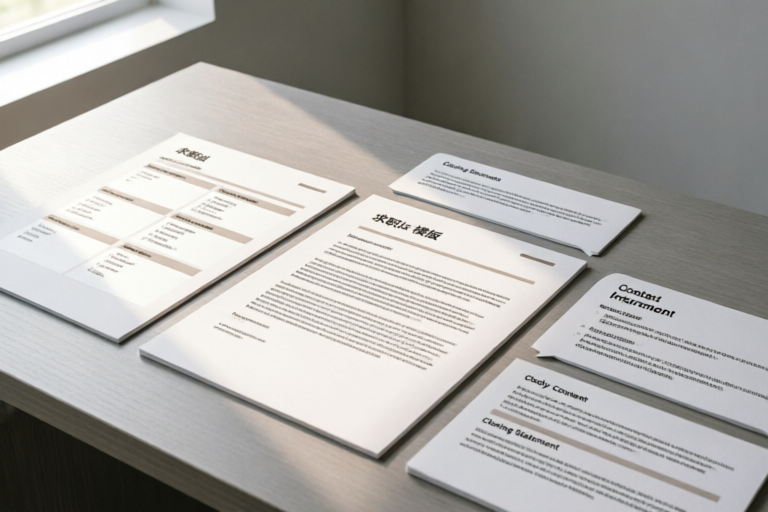
Job Application Cover Letter Templates for Beginners
Crafting the Perfect Cover Letter for Your Next Opportunity
1. Introduction to Job Application Cover Letters
A well-crafted cover letter can be the difference between landing an interview or being overlooked. It’s your chance to introduce yourself, highlight your qualifications, and express enthusiasm for the position. For beginners, understanding the basics of cover letters is crucial. This guide will walk you through the importance of a well-written cover letter and what to expect from cover letter templates.
Importance of a Well-Written Cover Letter
A cover letter serves as an introduction to your resume. It provides context about why you are applying for the job and how your skills align with the company's needs. A strong cover letter can catch the hiring manager’s attention and set you apart from other candidates.
Overview of What a Beginner Should Expect from Cover Letter Templates
Cover letter templates provide a framework for beginners to follow. They help structure your thoughts and ensure that all necessary information is included. However, it’s important to remember that these templates are just starting points. You’ll need to customize them to fit your personal experience and the specific job you’re applying for.
2. Essential Components of a Cover Letter
Your cover letter should be concise yet comprehensive. Here’s a breakdown of the key sections:
Opening Paragraph: Grabbing the Reader's Attention
The opening paragraph should grab the reader’s attention and introduce yourself. Mention the position you’re applying for and how you heard about it. Be clear and direct, but also show some personality. For example:
“I am writing to apply for the [Job Title] position at [Company Name], which I learned about through [Source]. With my background in [Field/Industry], I am excited about the opportunity to contribute to your team.”
Middle Paragraphs: Highlighting Skills and Experiences
The middle paragraphs are where you elaborate on your qualifications. Use this space to highlight relevant skills, experiences, and achievements. Tailor each section to the specific job you're applying for. For example:
“In my previous role at [Previous Company], I successfully managed a team of [Number] employees, leading to a [Percentage]% increase in productivity. My experience in [Skill/Technology] has equipped me with the tools necessary to excel in this new position.”
Closing Paragraph: Expressing Interest and Next Steps
In the closing paragraph, reiterate your interest in the position and express your willingness to discuss it further. Provide contact information and invite the reader to reach out. For example:
“I look forward to the opportunity to discuss how my background, skills, and enthusiasms can contribute to the success of [Company Name]. Please feel free to contact me at [Phone Number] or [Email Address] to schedule an interview.”
3. Sample Cover Letter Templates for Different Industries
Depending on the industry, your cover letter may need to emphasize different aspects of your experience. Below are sample templates tailored for various fields:
Template for Entry-Level Positions
Entry-level positions often require less emphasis on extensive work experience and more focus on potential and enthusiasm. Here’s a template for entry-level candidates:
Dear Hiring Manager, I am writing to apply for the [Job Title] position at [Company Name], which I learned about through [Source]. As a recent graduate with a degree in [Field/Industry], I am eager to bring fresh perspectives and a passion for learning to your team. During my studies, I completed internships at [Company 1] and [Company 2], where I gained valuable experience in [Skill 1] and [Skill 2]. These experiences have prepared me to take on the challenges of this role and contribute to [Company Name]'s success. I am excited about the opportunity to join your team and bring my enthusiasm and skills to [Company Name]. Please feel free to contact me at [Phone Number] or [Email Address] to schedule an interview. Sincerely, [Your Name]
Template for Creative Fields (e.g., Design, Marketing)
Creative fields like design and marketing require a more personalized and visually appealing approach. Here’s a template for creative professionals:
Dear [Hiring Manager's Name], I am writing to apply for the [Job Title] position at [Company Name], which I discovered through [Source]. With a portfolio of [Number] projects and over [Number] years of experience in [Field/Industry], I am confident in my ability to bring innovative ideas to your team. My work at [Previous Company] involved [Project Description], resulting in [Outcome]. My creative process is driven by [Approach/Philosophy], ensuring that every project is both functional and visually stunning. I am particularly drawn to [Company Name] because of [Reason], and I would love the opportunity to contribute to your upcoming projects. Please find my portfolio attached for your review. I look forward to discussing how I can contribute to your team. You can reach me at [Phone Number] or [Email Address]. Sincerely, [Your Name]
Template for Technical Roles (e.g., Software Development)
Technical roles often require a more formal and detailed approach. Here’s a template for technical professionals:
Dear [Hiring Manager's Name], I am writing to apply for the [Job Title] position at [Company Name], which I found through [Source]. With over [Number] years of experience in [Field/Industry], I have developed a deep understanding of [Technology/Framework], and I am excited about the opportunity to contribute to [Company Name]'s ongoing projects. At [Previous Company], I led a team of [Number] developers in the successful implementation of [Project Name], which resulted in [Outcome]. My expertise in [Skill 1], [Skill 2], and [Skill 3] has equipped me with the technical knowledge necessary to excel in this role. I am particularly interested in working with [Company Name] because of [Reason], and I am excited about the possibility of contributing to your team. Please find my resume attached for your review. I look forward to discussing how I can support your projects. You can reach me at [Phone Number] or [Email Address]. Sincerely, [Your Name]
4. Tips for Customizing Your Cover Letter
While templates provide a solid foundation, it’s essential to tailor your cover letter to each job application. Here are some tips to help you customize your cover letter effectively:
Researching the Company and Job Description
Before you start writing, take time to research the company and the job description. Understand the company’s mission, values, and culture. Look for keywords in the job posting that you can incorporate into your letter. This will demonstrate that you’ve taken the time to understand the position and the organization.
Tailoring Your Language and Achievements to Fit the Role
Use language that aligns with the job description and the company’s tone. Highlight specific achievements that are relevant to the position. For example, if the job requires strong leadership skills, mention a time when you led a successful project or team.
Avoiding Common Mistakes in Cover Letters
Avoid generic statements and clichés. Instead, focus on what makes you unique and how you can add value to the company. Also, proofread your cover letter carefully to avoid spelling and grammatical errors. A clean, error-free document shows professionalism and attention to detail.
5. Formatting and Design Considerations
Formatting and design play a significant role in the overall effectiveness of your cover letter. Here are some considerations:
Choosing the Right Font and Layout
Select a professional font such as Arial, Calibri, or Times New Roman. Stick to a standard size, typically 10-12 points. Ensure that your letter is easy to read and well-organized. Use bullet points or short paragraphs to break up large blocks of text.
Incorporating Professional Design Elements
If you’re applying for a creative role, consider adding a professional logo or header. For technical roles, keep the design simple and focused on content. Always ensure that any design elements enhance readability and do not detract from the message.
Ensuring Readability and Accessibility
Your cover letter should be accessible to everyone, including those using assistive technologies. Use high-contrast colors, avoid overly complex layouts, and ensure that text is easily readable. Additionally, make sure your document is compatible with standard PDF readers and email clients.
6. Conclusion and Final Thoughts
Writing a compelling cover letter is a skill that takes practice. By following the tips and templates provided in this guide, you’ll be well on your way to crafting a cover letter that stands out. Remember to:
- Highlight your unique qualifications and experiences.
- Customize your letter for each application.
- Proofread carefully before submitting.
With persistence and refinement, you’ll develop the skills needed to create effective cover letters that land you interviews. For further learning and improvement, consider exploring online resources, attending workshops, or seeking feedback from mentors.
Comments

Maybe add a section on how to handle multiple applications at once. That would be helpful!

This is exactly what I needed. Saved this for future reference. 🙌

I followed the design tips and my cover letter looks super professional now. Thanks!

How do I tweak this for a non-profit organization? Any tips on making it more relevant?

The tech role template was solid but could use more specific examples for software development jobs.
For the creative field template, I added some personal touches that matched the company's vibe. Got a callback!

Used this template for my first job application and got an interview! It really helped me structure my thoughts.