Resume & Cover Letter Templates
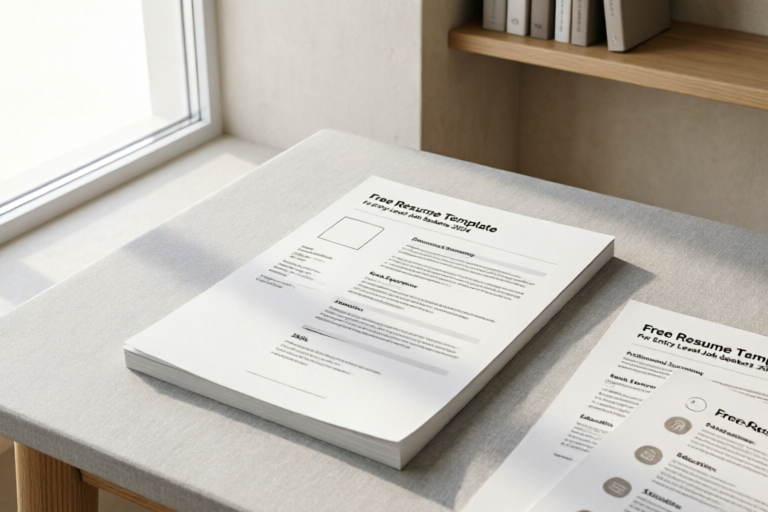
Free Resume Template For Entry Level Job Seekers 2024
Transform Your Potential into Opportunity Today
H1: Free Resume Template For Entry Level Job Seekers 2024
H2: 1. Introduction: Why Use a Template for Entry-Level Applications in 2024
The current professional landscape in 2024 is defined by unprecedented competition. With economic shifts, technological advancements, and an increasing number of graduates entering the workforce annually, securing your first full-time role has become more challenging than ever. Recruiters spend an average of six to seven seconds scanning a resume before deciding whether to move an applicant forward. In this hyper-competitive environment, making a strong first impression is not merely about qualification; it is about presentation.
For entry-level candidates, the blank page syndrome is a significant barrier. Unlike experienced professionals who have ample work history to populate their documents, recent graduates and career switchers often struggle with what to emphasize. They possess academic achievements, internships, and volunteer work, but framing these effectively requires structure. This is where a professionally designed template becomes invaluable. A template provides a scaffold upon which you can build your narrative, ensuring that your application adheres to industry standards regarding formatting, spacing, and hierarchy.
Furthermore, utilizing a structured template saves crucial preparation time. Crafting a document from scratch involves endless hours of adjusting margins, aligning columns, and selecting fonts to maintain consistency. A pre-built template eliminates these technical hurdles, allowing you to focus entirely on the content itself. In 2024, where digital submissions dominate, the ability to quickly iterate and customize your resume for specific roles is a strategic advantage. A template offers that flexibility, enabling you to tailor your skills and highlights without compromising design integrity.
H2: 2. Essential Components: Structuring Your Experience Without Traditional Work History
One of the biggest misconceptions among entry-level job seekers is that a resume requires years of employment experience to be considered viable. In reality, employers hiring for junior positions prioritize potential, transferable skills, and a strong foundational knowledge base over a decade of tenure. To compensate for a lack of corporate history, you must strategically restructure your resume to highlight education, projects, and soft skills. Here are the critical sections you must include:
H3: Education: More Than Just a Degree
Your education section is likely your strongest asset. For new graduates, this should appear near the top of the document, immediately following your contact information. Do not simply list the university name and major. Instead, elaborate with relevant coursework, GPA (if above 3.5), honors, and scholarships. For instance, listing "Coursework: Data Structures, Algorithms, Machine Learning Fundamentals" gives recruiters a glimpse into your technical literacy.
Additionally, include thesis titles or capstone projects briefly. If you graduated recently, omit high school information unless it holds significant relevance to the position. The goal is to signal academic rigor and dedication.
H3: Technical Skills and Tools Proficiency
In 2024, technical literacy is a baseline requirement across almost all sectors. Whether you are applying for marketing, engineering, or finance, you must clearly categorize your hard skills. Group these into logical clusters such as Programming Languages, Software Proficiency, Analytical Tools, and Languages Spoken. Be specific rather than vague. Avoid writing "Microsoft Office" and instead specify "Excel (Pivot Tables, VLOOKUP, Macros)" or "Advanced PowerPoint Design."
This specificity allows Applicant Tracking Systems (ATS) to match keywords from the job description to your profile accurately. If the job description asks for "Python," ensure the word "Python" appears explicitly in your skills section.
H3: Academic and Personal Projects
When formal work history is thin, projects act as your proxy for experience. Describe any significant assignments completed during your studies. Did you lead a team for a group case study? Did you code a small application? Did you organize a fundraising event for a club?
Use the STAR method (Situation, Task, Action, Result) to describe these experiences. For example: "Led a team of four students to develop a financial forecasting model for a local startup, resulting in a B+ grade and recognition for data accuracy." Quantifiable results are powerful here. Numbers catch the eye and demonstrate tangible impact, proving you can apply theoretical knowledge in real-world scenarios.
H3: Volunteer Work and Extracurricular Leadership
Employers value well-rounded individuals who demonstrate leadership and empathy outside the classroom. Volunteer positions show initiative and community engagement. Similarly, involvement in student organizations, clubs, or sports indicates teamwork and commitment. Treat these entries with the same weight as employment. List the organization name, your role, dates of involvement, and a brief description of your responsibilities and achievements. For example, serve on the board of a charity or manage social media for a campus publication. These activities cultivate soft skills like communication, management, and negotiation, which are highly prized by recruiters.
H3: Certifications and Training
If you have taken online courses or earned certifications (such as Google Analytics, HubSpot, or PMP), add a dedicated certification section. In fast-evolving industries, continuous learning signals adaptability. Listing a relevant certificate demonstrates that you have proactively sought knowledge beyond your academic curriculum.
H2: 3. Design Best Practices: Balancing Creativity with ATS Compliance
While content is king, design is the crown that frames it. However, there is a fine line between creative flair and functional usability. Modern recruiting pipelines rely heavily on Applicant Tracking Systems (ATS) software to parse and rank resumes. If your design is too complex, the system may fail to read it, relegating your application to the trash bin regardless of your qualifications.
H3: Choosing the Right Layout
Keep your layout simple and linear. Single-column layouts are universally safer for ATS parsing because they mimic the flow of human reading. Two-column layouts can sometimes confuse older software, causing it to misinterpret the order of the text, scrambling your content in the recruiter’s view. Stick to a clean hierarchy where section headers are distinct and easy to identify.
Ensure you leave adequate white space. Crowded pages are difficult to read and suggest disorganization. Margins should be consistent, typically between 0.5 and 1 inch. Paragraphs should be broken into bite-sized chunks using bullet points. Long blocks of text cause visual fatigue; bullet points invite scanning.
H3: Typography and Fonts
Fonts play a critical role in readability and professionalism. In 2024, stick to standard, sans-serif or serif fonts that are widely available. Common choices include Arial, Calibri, Helvetica, Times New Roman, and Roboto. Avoid novelty fonts, script styles, or handwriting effects, as these can be unreadable by bots and look unprofessional.
Font size should remain between 10pt and 12pt for body text. Headings can be slightly larger (14pt to 16pt) to establish contrast. Never reduce font size below 10pt to force content onto a single page; instead, cut unnecessary content. The goal is legibility.
H3: Graphics and Icons
Visual elements like icons, charts, or infographics add personality but introduce risk. While some modern ATS systems can handle images, many cannot extract text embedded within graphics. Consequently, do not place critical keywords or data inside icons or photos. Text should always be selectable and machine-readable.
Color usage should be subtle. A monochrome black-and-white palette is the safest bet for ATS compatibility. If you use color, limit it to section headings or borders. Avoid bright reds or neons. Blue and dark grey convey trust and professionalism. Remember, when printed in black ink, your resume should still look cohesive without the color differentiation.
H3: File Format Standards
Unless specifically requested, save your resume as a PDF to preserve formatting. A PDF prevents the layout from shifting when viewed on different devices or operating systems. However, note that some older ATS systems struggle with scanned PDFs. Always export a digital, text-based PDF, not a photo of a document. Alternatively, a Microsoft Word (.docx) file is universally accepted by almost all recruitment software. Having both versions ready is the smartest strategy.
H2: 4. Top Resources: Where to Find Verified Free Template Downloads
With countless options available, finding a trustworthy source for templates can be overwhelming. Many websites offer templates disguised as free services that subsequently lock premium features behind paywalls. Below is a curated list of reliable platforms offering updated formats for 2024 standards.
H3: University Career Centers
Many universities partner with vendors to offer free resume assistance to alumni. Check your alma mater’s career services portal. Schools like Stanford, Harvard, and Penn State provide direct links to templates vetted by career counselors. These are often the most tailored for fresh graduates, focusing heavily on the education and internship sections. Using a university-approved template also looks legitimate.
H3: Google Docs Template Gallery
Google Docs offers a built-in gallery of resume templates that are completely free and easily customizable. They are cloud-based, meaning you can edit them on any device. Navigate to File > New > From Template and filter by "Resume." Options like the "Serif" or "Swiss" templates provide clean, minimalistic structures that pass ATS tests effortlessly. Because they store automatically, you avoid the risk of losing work.
H3: Canva and Graphic Design Platforms
Canva is excellent for users seeking visual creativity. While some templates require a Pro subscription, many robust free options exist. Look specifically for the ones labeled "Minimalist" or "Simple." When downloading, choose the PDF Print option to ensure high resolution. However, exercise caution: ensure the text remains selectable after saving. If Canva exports your resume as an image, the ATS will fail to read it.
H3: Government and Non-Profit Career Sites
Organizations like USAJobs.gov offer standardized resume builders that adhere to federal guidelines, which often translate well to corporate ATS systems due to their structural simplicity. Non-profits like Idealist.org often share curated lists of design resources for non-profit and general sector applications. These sources tend to be ad-free and unbiased compared to commercial sites.
H3: Industry-Specific Repositories
Certain websites specialize in specific fields. For tech roles, GitHub or developer blogs often link to open-source markdown templates that engineers prefer. For creative roles, Behance or Dribbble hosts portfolio-style resume concepts. Search for “free resume templates 2024 GitHub repositories” to find community-vetted files that developers have tested for bug-free formatting.
H2: 5. Final Checklist: Customization and Submission Guidelines
Before clicking “Send,” rigorous testing is essential. Even the most beautiful template fails if the content is generic or riddled with errors. Follow this comprehensive checklist to ensure your submission is flawless.
H3: Proofreading and Error Checking
Typos create a perception of carelessness. Run your text through spell check, but do not rely solely on it. Humans miss obvious context errors that spell checkers ignore. Ask a friend, mentor, or family member to review your resume. Read it backwards to break the flow and catch individual word errors. Pay attention to verb tenses: use past tense for previous jobs and present tense for current roles. Ensure date formatting is consistent throughout (e.g., all MM/YYYY or Month Year).
H3: Keyword Optimization and Tailoring
Generic resumes rarely get interviews. You must tailor your template to the specific job description. Analyze the posting for recurring keywords and phrases. If they ask for “Project Management” twice, ensure that exact phrase appears in your experience or skills section. Remove sections irrelevant to this specific application. If the job emphasizes “Public Speaking,” remove “Data Analysis” if it competes for space. Your goal is to make the recruiter see you as the perfect fit immediately.
H3: File Naming Conventions
Never submit a file named “Resume.pdf” or “MyResume_Final_V2.docx.” Such names are lazy and prone to getting lost in crowded inboxes. Adopt a professional naming convention: FirstName_LastName_Resume_JobTitle.pdf. For example, “Jane_Doe_Resume_MarketingCoordinator.pdf.” This helps HR managers track and sort applications efficiently.
H3: Cover Letter Integration
A resume often stands alone, but a well-crafted cover letter enhances its impact. Ensure the header of your resume matches the header of your cover letter (same font, same contact details). Mention the specific company name in the opening paragraph. Connect your template choice to professionalism—it shows attention to detail. If the company applies via email, paste a brief introductory message in the body of the email rather than relying solely on the attachment to convey personality.
H3: Testing Across Devices
Before sending, download your own resume and open it on a smartphone and a tablet. Most recruiters access attachments on mobile devices during commutes. Ensure the text does not overflow, the columns stay aligned, and the bullet points display correctly on smaller screens. If the mobile view is distorted, switch to a single-column layout.
H3: Export Quality Verification
Verify that the file size is reasonable. Attachments over 5MB might bounce or trigger spam filters. Compress your PDF if necessary. Open the file to ensure no watermarks appear (some free Canva templates add a watermark to the bottom corner). If the background colors shift to grey upon export, simplify the theme. Finally, double-check the active links. If you include a LinkedIn URL or portfolio site, click them to ensure they route correctly.
Conclusion
Landing a job as an entry-level candidate requires a combination of patience, strategy, and preparation. By leveraging a free, ATS-friendly resume template for entry-level job seekers in 2024, you level the playing field against competitors with more resources. Remember that your resume is a living document. Continuously update it with new skills, projects, and feedback you receive from rejection letters or interviews. A well-designed document does not guarantee success, but it guarantees that you are seen fairly. Equip yourself with the right tools, polish your narrative, and present your potential with confidence. Your career journey begins with the quality of your introduction.
Comments

NullPointer
finally one that actually mentions academic projects properly. most ignore students completely tbh
👍 13👎 0
Sara_L
clean design! i hate all those crazy graphics that get rejected by bots anyway. will definitely update keywords next time
👍 26👎 0

ResumeProTips
small suggestion: put skills near the top if you dont have work exp. that caught the recruiter eye faster for me
👍 24👎 0

JobHunter_X
literally saved my life rn. had to submit something in an hour and found this at midnight. thanks!!
👍 10👎 0

IT_Guy_Dave
does this work well in word doc? trying to avoid google docs weird formatting shifts when downloading pdf
👍 10👎 0
FreshGrad24
just applied with this and honestly feeling way more confident. the layout is super clean which is half the battle
👍 0👎 0