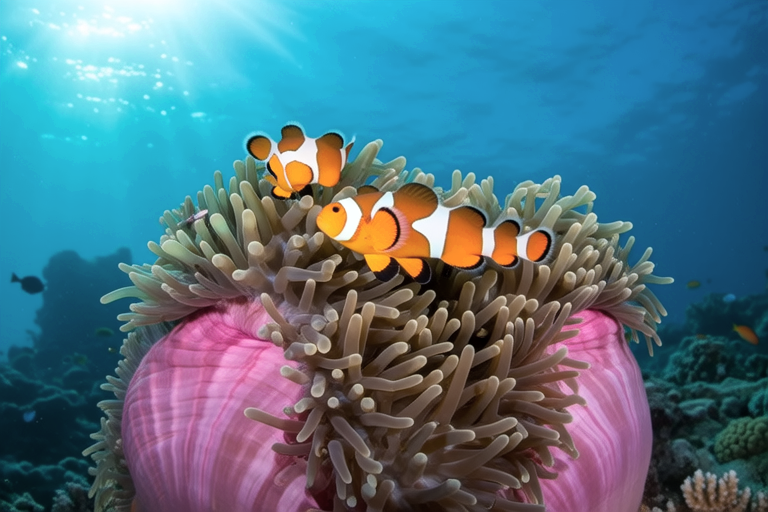
Clownfish and Anemones: A Match Made in Marine Paradise
The ocean teems with countless forms of life, each playing a unique role in its ecosystem. Among the most captivating and intriguing relationships within this vast underwater world is the symbiotic bond between clownfish and sea anemones. This dynamic duo, often showcased in popular media like Disney’s “Finding Nemo,” has captured the hearts and imaginations of people worldwide. But beyond its charm lies a remarkable tale of adaptation, mutual benefit, and survival.
The Symbiotic Relationship
Symbiosis, broadly defined, refers to any close and long-term interaction between two different biological species. In the case of clownfish and anemones, it is a mutualistic relationship where both parties benefit from the association. Clownfish, also known as anemonefish, are small, brightly colored fish that live among the tentacles of certain sea anemones. These anemones are stationary marine animals related to jellyfish and coral, characterized by their long, flowing tentacles.
The relationship between clownfish and anemones is mutually beneficial in several ways. For the clownfish, the anemone provides protection from predators. The clownfish’s mucus coating allows them to move freely among the anemone’s stinging tentacles without being harmed. This protection enables clownfish to thrive in environments where they would otherwise be vulnerable. Additionally, the anemone serves as a home for the clownfish, offering shelter and a place to lay eggs. In return, the clownfish help the anemone by providing food through their waste products and attracting prey with their movements. They also defend the anemone against herbivorous fish that might otherwise consume it.
Unique Adaptations
The ability of clownfish to live safely among anemones’ tentacles is due to a unique adaptation. Unlike most other fish, clownfish have a special layer of mucus on their skin that prevents the anemone’s stinging cells, called nematocysts, from firing. This adaptation is believed to develop over time as clownfish juveniles rub against the anemone’s tentacles, gradually building up the protective mucus layer. Without this adaptation, the clownfish would be paralyzed or even killed by the anemone’s venomous sting.
Anemones also possess specific traits that contribute to the success of this partnership. Their tentacles are lined with specialized cells called nematocysts, which are used to capture prey and deter predators. However, these same cells can be dangerous to the anemone itself if not properly regulated. The clownfish’s presence helps regulate the anemone’s nematocyst activity, ensuring that they remain effective against threats but do not harm the clownfish. Moreover, clownfish have been observed fanning the water around the anemone, increasing oxygen flow and helping to keep the anemone healthy.
Behavioral Insights
Clownfish exhibit fascinating behaviors that enhance their relationship with anemones. For instance, they are fiercely territorial and will defend their host anemone from intruders. This defensive behavior includes chasing away potential predators and competing anemonefish. Interestingly, clownfish are highly social and typically live in groups consisting of a dominant breeding pair and non-breeding members. Within this hierarchy, only the dominant pair reproduces, with the female laying thousands of eggs on the undersides of rocks or on the anemone’s base. The male then takes responsibility for guarding and caring for the eggs until they hatch.
Another intriguing aspect of clownfish behavior is their ability to change sex. If the dominant female dies, the next most dominant male will transform into a female, allowing reproduction to continue. This remarkable flexibility ensures the survival of the species and underscores the importance of maintaining the population balance within the group.
Habitat Preferences
Clownfish and anemones inhabit tropical and subtropical waters, primarily found in the Indo-Pacific region, including the Great Barrier Reef off Australia, the Red Sea, and parts of Southeast Asia. They prefer shallow, warm waters near coral reefs, where anemones thrive. Coral reefs provide a diverse and complex environment that supports a wide range of marine life, making them ideal habitats for both clownfish and anemones.
Within these reef ecosystems, anemones are often found attached to hard surfaces such as rocks or coral formations. Clownfish, in turn, select anemones based on factors like size, location, and the presence of potential competitors. Once a suitable anemone is chosen, clownfish establish themselves as residents and begin to form the strong bond that characterizes their relationship.
Why This Relationship is Fascinating
The symbiotic relationship between clownfish and anemones is one of nature’s most fascinating examples of mutualism. It showcases the intricate web of interactions that sustain life in marine ecosystems. By studying this relationship, scientists gain valuable insights into the mechanisms of symbiosis and the evolutionary processes that drive the development of such partnerships.
This relationship also highlights the importance of biodiversity and the interdependence of species within ecosystems. The loss of either clownfish or anemones could disrupt the delicate balance of their shared habitat, potentially leading to cascading effects throughout the entire ecosystem. Understanding and preserving these relationships is crucial for maintaining the health and resilience of our oceans.
Conclusion
The partnership between clownfish and anemones exemplifies the beauty and complexity of life in the ocean. Through their unique adaptations and behaviors, these two species have formed a relationship that benefits both and illustrates the power of cooperation in nature. As we continue to explore and learn more about the mysteries of the deep, the story of clownfish and anemones remains a compelling reminder of the wonders that lie beneath the waves.
